The Kiln Decision: Why CBDa and CBD Behave So Differently on a Trade Invoice

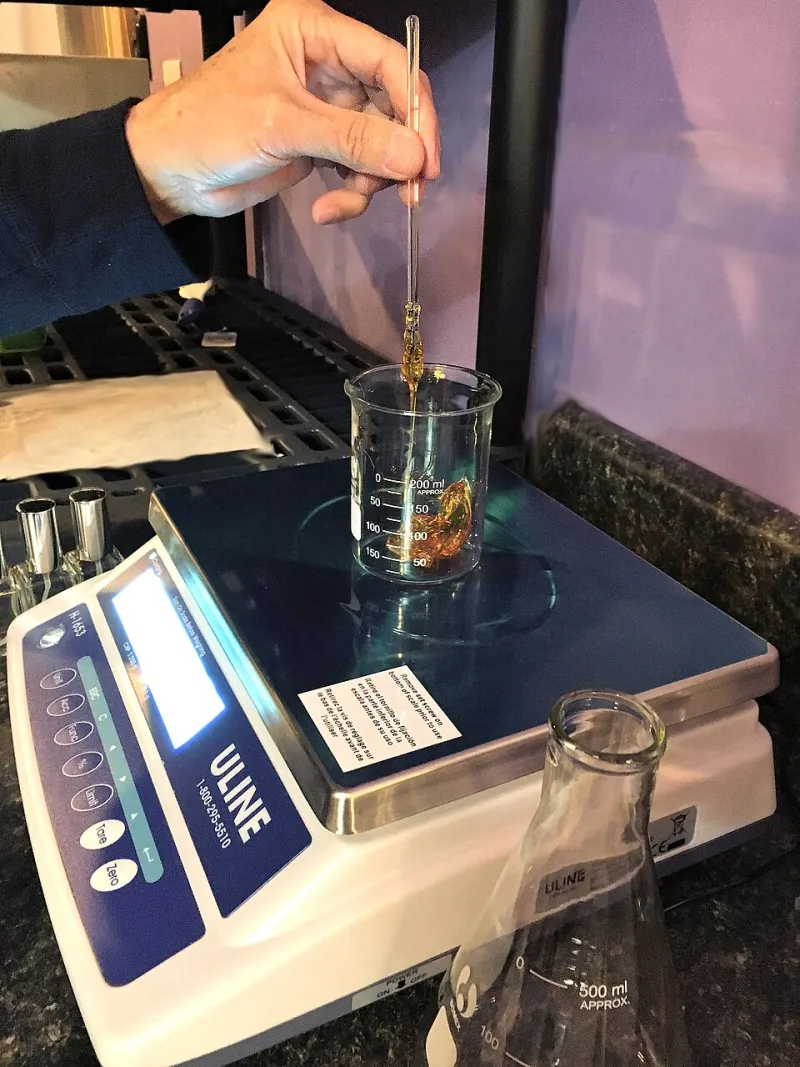
Photo: laboratory scientist cannabis oil extraction analysis beaker, via www.crbgroup.com
Anyone who has compared CBD invoices from three or four UK suppliers will have noticed a recurring oddity: the milligram figures look broadly interchangeable, yet the products behind them are not. Some oils are dark, thick and faintly tart. Others are pale, thin and neutral. Some have a cannabinoid profile dominated by CBD; others carry substantial quantities of cannabidiolic acid. The dividing line is a single processing step, and it is frequently described on trade paperwork with a word or two at most.
Two Molecules, One Label
Raw cannabis and hemp plants do not produce much CBD as such. They produce cannabidiolic acid, usually abbreviated to CBDa — a carboxylated precursor that becomes CBD when the carboxyl group is driven off by heat. In unheated plant material, CBDa typically dominates; after sufficient heating, the balance shifts decisively towards CBD.
This matters commercially because most labelling regimes, including those in the UK, express content in terms of CBD rather than total cannabinoids. A product that has never been heated may contain very little CBD in the strict sense, however much CBDa it holds. A label claiming a CBD figure for an unactivated oil is therefore either an error, a use of loose terminology, or a claim that requires a careful conversation.
What Decarboxylation Actually Is
Decarboxylation is a time-and-temperature relationship, not a switch. The reaction proceeds faster at higher temperatures and slower at lower ones, and the same target conversion can be reached by several different combinations. Typical trade practice sits somewhere in the region of 100 to 150 degrees Celsius over a period measured in tens of minutes, though specific parameters vary widely and are often treated as proprietary.
Two consequences follow. First, conversion is rarely total. Almost all activated oils retain a residue of CBDa, and the ratio between the two is a reasonable indicator of how thorough the process was. Second, the process does not stop at CBD. Prolonged or excessive heating encourages degradation, including conversion towards THC and the formation of unwanted by-products, and it drives off volatile terpenes — the aromatic compounds that many buyers value. There is a genuine trade-off between conversion efficiency and the preservation of the plant's more delicate constituents.
Why the Same Milligram Count Behaves Differently
Consider two oils, each declaring 1,000mg of CBD per 10ml bottle. In the first, the material was fully decarboxylated and the CBD figure is genuine. In the second, the supplier has measured total cannabinoids and translated the CBDa content arithmetically into a CBD equivalent without heating the oil. The bottles look identical on paper. They are not the same product.
The consequences reach further than potency. CBDa and CBD differ in solubility and stability, which affects how an oil performs in a carrier, how it behaves over a two-year shelf life, and how it responds to temperature during storage and transit. An unactivated oil may be marketed as 'raw' or 'full spectrum raw', which is a legitimate category — but it is a different category, and the buyer should be pricing it as such.
There is also a labelling dimension. Where a product carries a stated CBD figure, that figure should be supported by analysis of the finished oil rather than derived by calculation. Buyers who accept arithmetic substitutes for measurement are effectively underwriting someone else's compliance risk.
Reading the Paperwork
The invoice and accompanying certificate are where this should become clear, and often do not. Useful signals include:
- Separate columns for CBD and CBDa, with the analytical method named. A single 'total cannabinoids' line tells you little about what has been done to the material.
- The word 'decarboxylated' or 'activated' used consistently across the specification, the certificate and the marketing copy. Inconsistency here is a warning sign.
- A stated conversion ratio or residual CBDa figure. Suppliers who track this are usually suppliers who understand their own process.
- Batch-specific results, not a specification sheet repurposed from a development batch.
Where none of this appears, a direct question usually settles it: is the declared CBD figure measured or calculated, and can the laboratory report be shared in full?
The Cost Side of the Equation
Decarboxylation is not free. It consumes energy, occupies reactor time, adds a process step that must be validated and requires the material to be handled at temperature — which introduces loss and, in poorly controlled operations, a quality risk. Trade pricing for activated material should reflect that. When an unactivated oil is quoted at the same rate as a properly activated one of equivalent declared strength, it is worth asking which cost has been left out.
Conversely, raw material carries its own economics. Because CBDa converts to CBD at a rough mass ratio of about 0.87 to 1, a supplier selling on a CBD-equivalent basis from unheated material is quoting against a figure the customer will never see in the bottle.
Questions to Put to a Supplier
The practical checklist is short. What are your decarboxylation parameters, and how are they validated? Is the declared CBD content measured on the finished oil? What proportion of CBDa remains, and is that disclosed? How does the process affect terpene content, and is that accounted for in the specification? Which carrier oil was used, and was it added before or after heating?
None of these questions is adversarial. Good suppliers answer them with documents and, occasionally, with a note of enthusiasm — because the process is the part of the business they know best.
The Takeaway
Decarboxylation sits quietly at the centre of CBD trade economics: it determines what the product contains, what it can lawfully claim, how it will age and what it should cost. For UK buyers, the discipline is to stop treating milligram figures as a like-for-like comparison and start asking what was heated, for how long, and how anyone knows. The answers distinguish a well-documented product from a well-presented one.